

Posted by Jonathan Atan
on November 14, 2025

When you grab a knee pain foam roller, the most important rule is this: you're working on the muscles around the knee, not the joint itself. Real relief comes from focusing on tight spots in your quads, hamstrings, and IT band—the areas that often pull on your knee and cause that frustrating ache. This simple tool can help reduce soreness and promote recovery when used correctly.
Your Go-To Guide for Soothing Knee Discomfort
If you're tired of dealing with stiffness or a dull ache around your knees, you've come to the right place. This guide is all about using a foam roller to give those hard-working muscles surrounding your knee joint a bit of much-needed attention.
We're going to dive into how targeting your quads, hamstrings, and IT band can make a world of difference. It all comes down to myofascial release, which is a way of applying gentle, steady pressure to help loosen up tight connective tissues. That tightness, whether from sitting at a desk or hitting the gym, is often the hidden culprit behind knee strain.
Why Those Supporting Muscles Are So Important
Understanding the "why" here makes every foam rolling session more effective. Your knee doesn't work alone; it's part of a connected system.
- Quadriceps: These big muscles on the front of your thigh can get incredibly tight, yanking on your kneecap and affecting how it moves.
- Hamstrings: When the muscles on the back of your thigh are tight, it can change your walking pattern and put extra stress right on the knee.
- IT Band: If you're active, tension along this band on your outer thigh is one of the most common sources of knee discomfort.
Throughout this guide, we'll mention how tools like the Cryotex foam roller can help you get the job done. While foam rolling is fantastic for muscular issues, it's also smart to look at the bigger picture. If you're curious about other ways to manage discomfort, there are plenty of natural remedies for joint pain that can perfectly complement your recovery routine.
Finding the Real Source of Your Knee Pain
When your knee acts up, your first instinct is probably to blame the knee itself. But here's a secret from the world of physical therapy: your knee is often just the messenger, not the source of the problem. The real culprits are usually the tight, overworked muscles surrounding it.
Think of it this way: your knee joint is caught in a constant tug-of-war between major muscle groups. When one of those groups—like your quads or hamstrings—gets tight, it pulls the kneecap out of its normal path, creating friction and strain. For runners, a tight IT band is a classic example of an outside force causing chaos at the knee.
Why It's More Than Just Knee Deep
This is exactly why a knee pain foam roller can be a game-changer, but only if you use it correctly. Instead of rolling over the painful spot (which can sometimes make things worse), the goal is to target the tight muscles that are pulling everything off-kilter.
This approach is all about myofascial release—a technique designed to ease tension in the tough, web-like fascia that encases your muscles. It's a foundational concept in bodywork, and you can learn more about it in our guide on what myofascial release therapy is.
Sometimes, the imbalance starts even further down the chain. It’s surprisingly common to see knee pain linked to foot alignment, where issues in your feet cause a ripple effect all the way up your leg. By finding these root causes, you can stop wasting time and start foam rolling with a purpose.
"I always thought my knee pain was just from running, but my trainer in Chicago told me to focus on my quads and hips. Rolling those areas made a huge difference almost immediately. It’s about finding the real source." - A local customer.
This isn't just a niche idea anymore. The global foam roller market was valued at USD 1.03 billion and is projected to skyrocket to USD 2.31 billion by 2032. That’s a whole lot of people discovering how effective this simple tool can be for relief and recovery.
Key Muscle Groups Affecting Knee Health
To get the most out of your foam roller, you need to know where to focus your efforts. Most knee pain can be traced back to tightness in one of four key areas.
| Muscle Group | How It Affects the Knee | Foam Rolling Goal |
|---|---|---|
| Quadriceps (Front of Thigh) | Tight quads pull directly on the patella (kneecap), causing friction and pain underneath it. | Release tension to allow the kneecap to track properly. |
| Hamstrings (Back of Thigh) | Stiff hamstrings limit your range of motion and force other muscles, including those around the knee, to overcompensate. | Improve flexibility and reduce the posterior pull on the knee joint. |
| IT Band/TFL (Outer Thigh) | A tight IT band is famous for causing sharp, stabbing pain on the outside of the knee. | Loosen the TFL muscle (at the hip) and the surrounding fascia to reduce lateral knee strain. |
| Glutes & Hips | Weak or tight glutes lead to poor hip stability, causing the knee to collapse inward during movement. | Activate the glutes and release hip tightness to stabilize the entire leg. |
By targeting these specific muscle groups, you’re not just temporarily masking the pain—you’re addressing the mechanical issues that caused it in the first place. This is the difference between simply rolling and rolling smart.
How to Foam Roll Muscles Around the Knee
Okay, let’s get that foam roller working for you. The secret to getting real relief is to focus on the big muscles that support your knee, not the joint itself. Think of it like a deep-tissue massage that helps break up built-up tension.
We'll walk through the technique for each key muscle group. The goal here is slow and controlled movement. Breathe deeply to help everything relax. When you hit a tender spot, just pause and hold gentle pressure for 20–30 seconds until you feel the muscle start to release.
This visual perfectly illustrates how tightness elsewhere—like your quads from sitting or your IT band from running—can pull on the knee and cause that nagging pain.
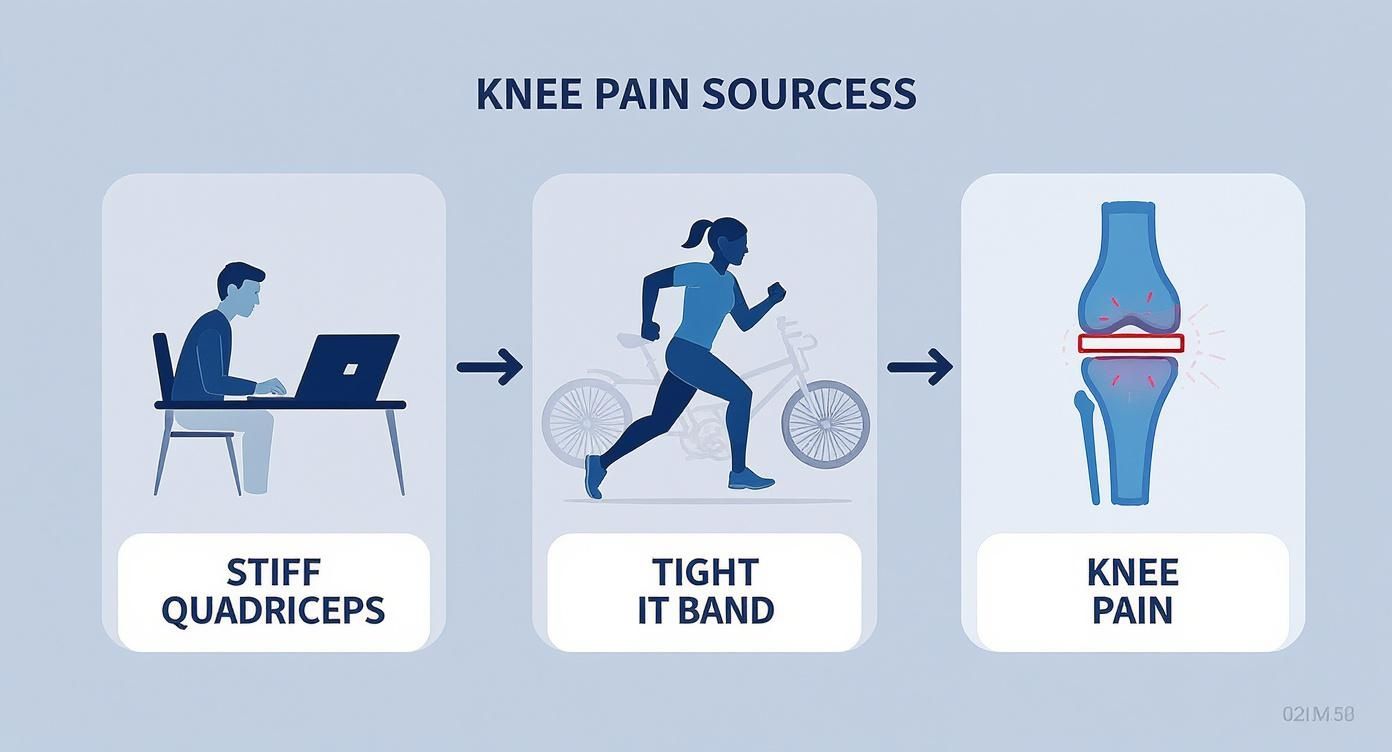
As you can see, knee pain is often just the messenger. The real problem usually starts somewhere else in the leg.
Targeting Your Quadriceps
Your quads, the big muscles on the front of your thigh, get incredibly tight from sitting all day or from activities like cycling. This tightness tugs on your kneecap, leading to that all-too-common ache right in the front of your knee.
To get started, lie face down and put the foam roller under your thighs. Prop yourself up on your forearms like you're in a low plank. From there, use your arms to gently roll your body forward and back, working the roller from the bottom of your hip down to just above your kneecap.
Releasing Your Hamstrings
Next up, the hamstrings. When the muscles on the back of your thighs are tight, it can throw off your posture and how you walk, which puts a ton of extra stress right on your knees.
Sit on the floor, legs out straight, with the roller underneath your thighs. Put your hands on the floor behind you for support and lift your hips. Slowly roll from just below your glutes down to the back of your knees. Want more pressure? Cross one leg over the other to really focus on one side at a time.
Addressing the IT Band and Hips
That thick band of tissue running down your outer thigh is the IT band. You never want to roll directly on the band itself—it can make things worse. Instead, focus on releasing the muscles that connect to it, like the TFL (tensor fasciae latae) up at your hip.
A local customer in New York shared, "I used to roll my IT band like crazy and it only made my knee pain worse. A trainer showed me how to focus on my TFL and glutes instead. Game changer."
Lie on your side with the roller just below your hip bone. Use your forearm to support your upper body and place your top foot on the floor in front of you for stability. Gently roll along the outer thigh, making sure to stop before you get to the side of your knee. If you want other options for this tricky area, you can learn how to use a massage gun for IT band relief in our guide.
Don't Forget Your Calves
Finally, don't overlook your calves. Tight calf muscles can mess with your ankle mobility, creating a chain reaction of stress that travels straight up to your knees.
Sit on the floor with the roller under your calves and your hands behind you for support. Lift your hips and begin rolling from your ankles up to the back of your knees. You can turn your legs in and out a bit to hit different parts of the muscle. It’s a simple move that makes a huge difference.
What Not to Do: Foam Rolling Mistakes That Can Make Knee Pain Worse
Mastering the right foam rolling moves is only half the battle. Knowing what to avoid is just as critical to making sure your sessions are actually helping, not hurting. Let's break down a few common mistakes we see all the time.
First and foremost, the golden rule: never roll directly on your kneecap or the soft part behind your knee. These are complex joints full of bones, ligaments, and tendons—not muscle. Putting direct, heavy pressure there can stir up irritation and make your pain worse.

Fine-Tuning Your Technique for Safe Relief
Getting the little details right can make all the difference between a frustrating session and real progress. Foam rolling should feel like productive, deep work—not a torture session.
A huge mistake is rushing through it. Flying back and forth over the muscle doesn't give the fascia time to release its grip. Think slow, intentional, and deliberate. Let the pressure sink in and do its job.
Another big one? Pushing through the wrong kind of pain. A "good hurt" on a tight spot is one thing, but sharp, stabbing pain is your body's alarm bell. Listen to it. Back off, shift your position, or move on to another spot.
The goal is to coax your muscles into relaxing, not to beat them into submission. If you're tensing up or holding your breath, you’re pushing way too hard. Ease up and breathe.
Starting with a roller that's too firm is a classic rookie error. If you're new to rolling, a super-dense roller can feel like a rock and leave you bruised. Something softer, like the Cryotex, lets your body ease into the practice. You can always level up to a firmer one later.
There's a reason the fitness foam roller market is projected to hit USD 800 million by 2032. More and more people are realizing that it’s an evidence-backed tool for supporting circulation and flexibility. You can read more about the growth of the foam roller market and its role in recovery.
Making Foam Rolling a Consistent Habit
If you want lasting relief, the secret isn't how hard you roll—it's how often you do it. Turning this simple habit into a regular part of your routine is what creates real, sustainable change for the muscles supporting your knees.
Think about the best times to slip it in. A quick session before a workout can warm up your muscles and improve flexibility. Rolling after a long day helps release tension that's built up from hours of sitting or standing. Honestly, even five minutes can make a difference.
Simple Routines for Any Lifestyle
Building a new habit is way easier when it fits your existing schedule. Here are a few practical ideas to get you started:
- For Office Professionals: A quick 5-minute roll targeting your quads and hamstrings after work can help undo hours of sitting.
- For Runners: Spend 10 minutes before your run focusing on your calves, quads, and glutes. It’s a great way to prep your legs for impact.
- For Older Adults: A gentle mobility session in the morning can help ease stiffness and improve your range of motion for the rest of the day.
The goal is to make foam rolling feel like a natural part of your wellness toolkit, not just another chore on your to-do list.
It's no surprise that foam rolling has become so popular. In North America alone, foam rollers command over 40% of the regional market share, a trend driven by high fitness engagement and widespread use in physical therapy. You can dig into more details about global fitness market trends. This widespread adoption just goes to show how effective these simple tools really are.
And remember, addressing tightness in other areas can have a positive ripple effect. If you also deal with tension below the knee, our guide on how to treat tight calf muscles offers some great complementary techniques that can further support your legs.
Your Foam Rolling Questions Answered
Alright, let's clear up some of the common questions that pop up when you're just getting started with a knee pain foam roller. Getting these answers straight will help you roll with confidence and see better results.
How Often Should I Use a Foam Roller for Knee Pain?
Think consistency, not intensity. A quick 5-10 minute session every day or every other day is often all you need to start feeling a difference.
If you’re pretty active, rolling out the muscles around your knee before and after you exercise can be a game-changer for recovery. And listen to your body! If you feel overly sore from a session, that's your cue to take a day off. This is about muscle maintenance, not an intense workout.
Should Foam Rolling Be Painful?
You're going to feel some discomfort on those really tight spots—it's often called a "good ache." But you should never feel sharp, stabbing, or unbearable pain.
Pain is your body's alarm bell. If you hit a spot that feels truly painful, ease up on the pressure, shift your position, or just move on to another area. The goal here is to release tension, not to cause bruises or more inflammation.
Can I Foam Roll with Arthritis in My Knee?
This is a really important one. If you have arthritis or another medical condition impacting your joints, you absolutely need to talk to your doctor or physical therapist first.
While rolling the supporting muscles (like your quads and hamstrings) can sometimes help by taking some strain off the joint, rolling directly over an arthritic knee could make things worse. Always get professional medical advice that's specific to your situation.
A local customer from Los Angeles told us, "My physical therapist gave me the green light to roll my quads, and it's helped my arthritic knee feel more supported. But I never go near the joint itself."
Which Is Better: A Smooth or Textured Roller?
For beginners, a smooth roller like the Cryotex model is your best bet. It provides broad, even pressure that lets your muscles get used to the sensation without being too aggressive.
Textured rollers, with their bumps and ridges, are designed for deeper, more targeted work on serious knots. They're great, but they're more of an advanced tool. Stick with a smooth surface to start—it's safer and more effective when you're learning the ropes.
Ready to make foam rolling a part of your wellness routine? The right tools can help you get started on the right foot.
