

Posted by Jonathan Atan
on December 02, 2025

That subtle ache after a long day at your desk? The stiffness you feel standing up after a workout? For many of us—from dedicated athletes to busy office professionals—tight hip flexors are a common issue that can lead to lower back discomfort and limited mobility.
Ignoring this tension can impact everything from your daily comfort to your athletic performance. But what if you could unlock better movement with just a few minutes a day? This guide provides the best stretches for tight hip flexors, with simple, step-by-step instructions to help you move freely and feel your best.
We’ll explore seven effective stretches, explaining how to do them and why they work. You’ll also learn how to enhance your routine and promote recovery by using tools like the Cryotex Massage Gun. Whether you want to improve flexibility, reduce soreness, or counteract the effects of sitting, this is your resource for more comfortable movement. Let’s get started.
1. Couch Stretch (90/90 Hip Flexor Stretch)
Popularized by mobility experts, the Couch Stretch is a powerful tool for unlocking chronically tight hips. It delivers one of the most intense and effective stretches for your hip flexors, particularly the psoas and rectus femoris (a quadriceps muscle). It’s an essential part of any routine focused on finding the best stretches for tight hip flexors, as it addresses tension from prolonged sitting.
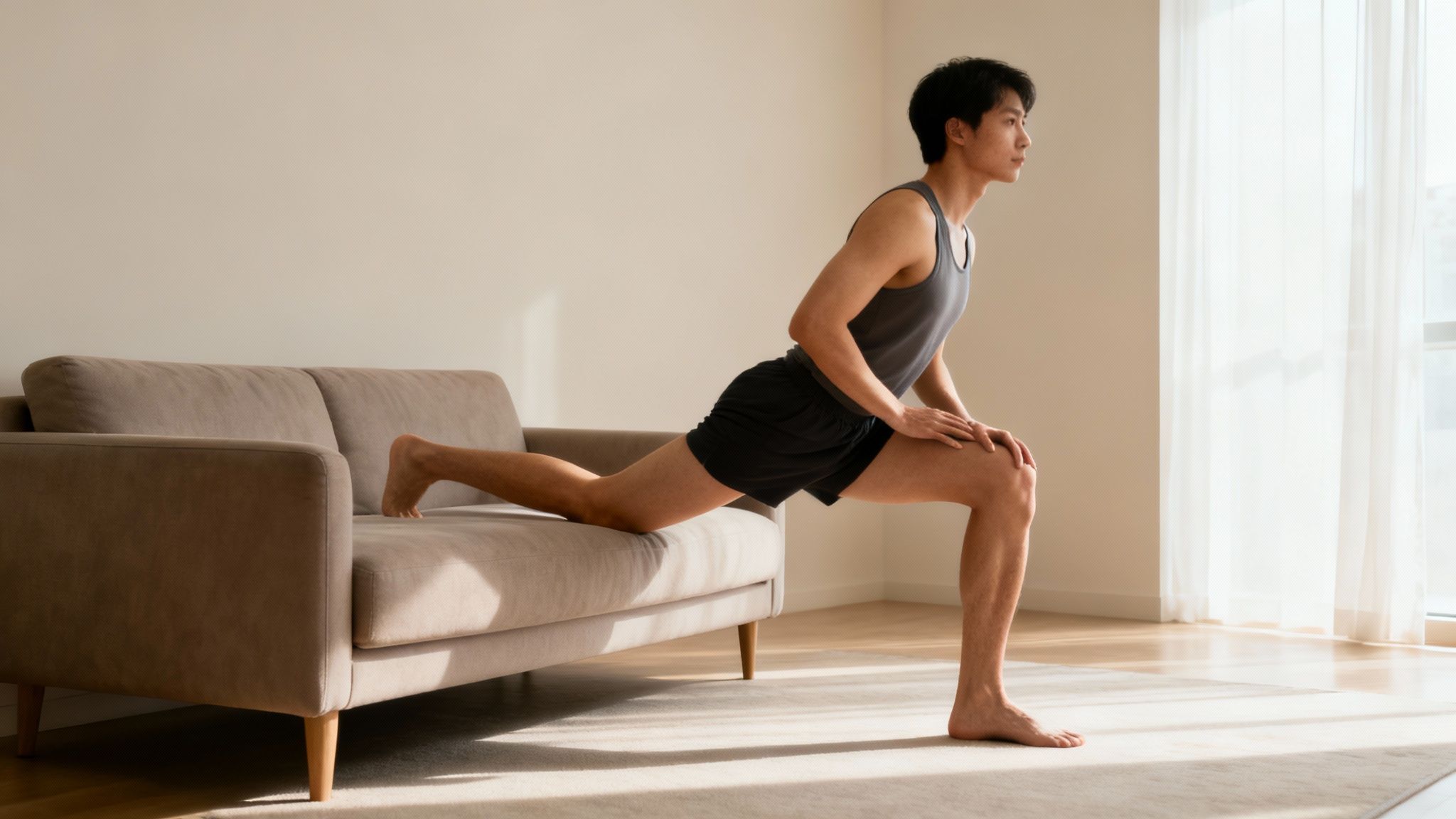
This stretch is highly adaptable. Athletes use it to improve squat depth and power, while runners use it to maintain hip extension. For office workers, it directly counteracts the hip-shortening effects of sitting at a desk all day.
How to Perform the Couch Stretch
- Get into Position: Place a pad on the floor next to a couch or sturdy chair. Kneel on the pad with the leg you want to stretch, sliding your knee back so it touches the base of the couch.
- Elevate Your Foot: Place the top of your back foot up against the vertical part of the couch.
- Step Forward: Bring your other foot forward and plant it on the floor, creating a 90-degree angle at your knee, like a lunge.
- Engage Your Core: Keep your torso upright, gently squeeze your glutes, and engage your core. This action tilts your pelvis backward and intensifies the stretch. Hold for 60-120 seconds per side.
Pro Tip: If the stretch is too intense, start with a lower surface. As your flexibility improves, you can progress to a taller surface to deepen the stretch.
Pairing with a Massage Gun
To enhance the benefits, use a massage gun like the Cryotex Massage Gun on your quadriceps and hip flexor area before stretching. Using a round attachment for 30-60 seconds on a low setting helps warm up the muscle tissue. This can help reduce tension, allowing you to achieve a more comfortable stretch.
2. Low Lunge (Anjaneyasana)
A foundational pose in yoga, the Low Lunge is one of the most accessible movements for releasing tension in the hip flexors. This gentle yet powerful stretch targets the iliopsoas and rectus femoris, making it ideal for beginners and athletes. As one of the best stretches for tight hip flexors, it can be held as a static stretch or used in a dynamic flow to warm up the hips.
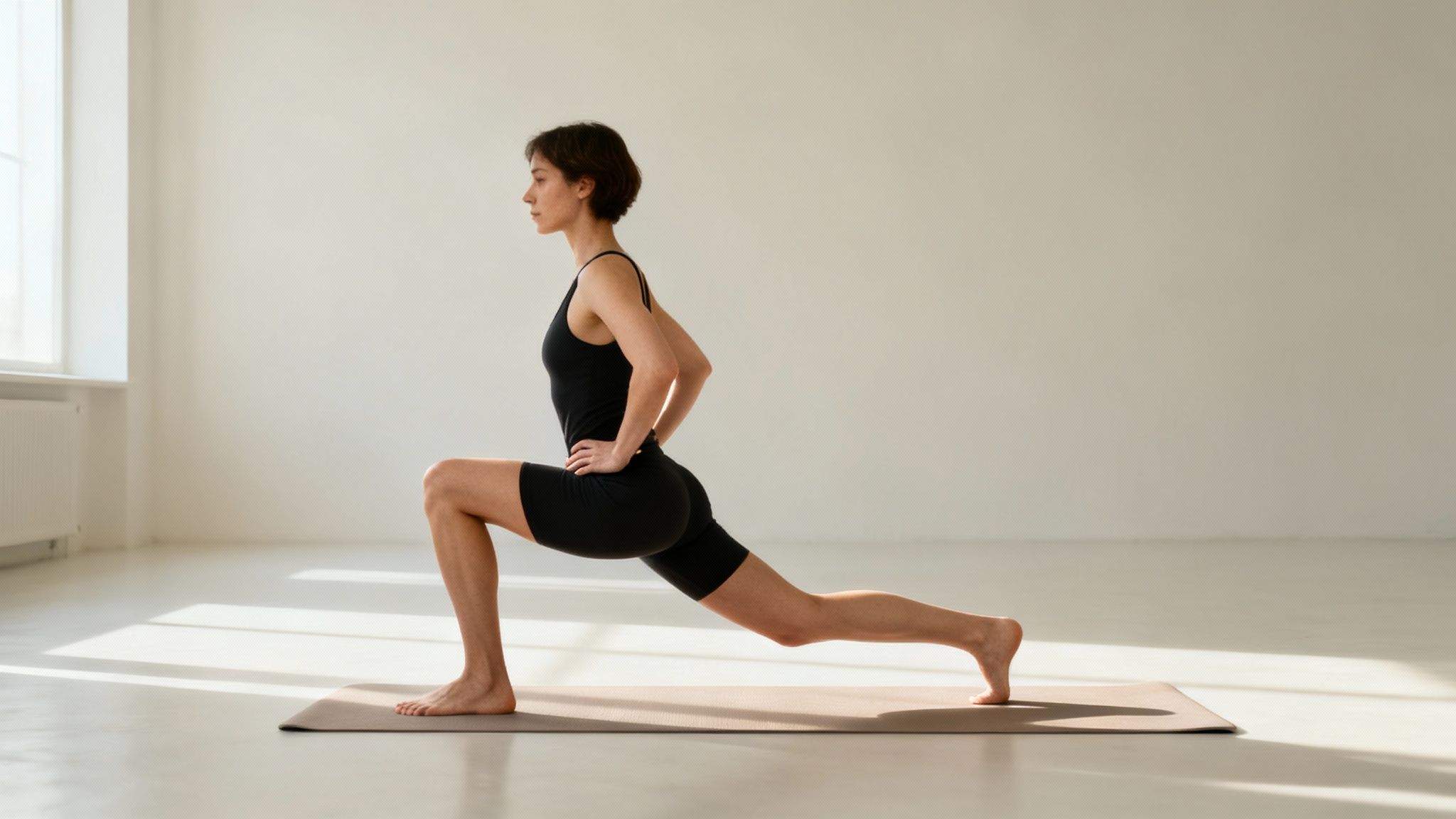
The Low Lunge is a staple for good reason. Yoga practitioners use it to build flexibility, while runners often include it in pre-run warm-ups. It's also frequently recommended as a safe way to improve hip mobility and counteract a sedentary lifestyle.
How to Perform the Low Lunge
- Start on All Fours: Begin on your hands and knees on a yoga mat or soft surface.
- Step One Foot Forward: Step your right foot forward between your hands, aligning your right knee directly over your right ankle.
- Extend the Back Leg: Slide your left knee back until you feel a comfortable stretch along the front of your left thigh and hip. You can place a towel under your back knee for comfort.
- Lift Your Torso: Place your hands on your front thigh and lift your torso upright. Engage your core and gently sink your hips forward and down. Hold for 30-60 seconds, then repeat on the other side.
Pro Tip: For a deeper stretch, raise your arms overhead. This lengthens the entire front of the body, from the hip flexor up through the abdomen.
Pairing with a Massage Gun
Using a massage gun before your Low Lunge can enhance its effectiveness. Target the front of your hip and quadriceps with the Cryotex Massage Gun for 30-60 seconds. This pre-stretch massage helps support circulation and warm up the muscle tissue, allowing you to sink deeper into the lunge.
3. Pigeon Pose (Eka Pada Rajakapotasana Preparation)
Pigeon Pose is a profound hip opener used in yoga and mobility practices. While it targets the external rotators of the hip, it also provides an effective release for the hip flexors on the extended back leg. This makes it one of the best stretches for tight hip flexors, especially for those who feel tension deep within the hip joint.
This restorative pose is a staple in yoga classes to promote hip mobility. Dancers incorporate it into their routines to enhance flexibility, and physical therapists often recommend it to clients with hip-related stiffness. It’s a versatile stretch that can be modified for any flexibility level.
How to Perform the Pigeon Pose
- Start in a Tabletop Position: Begin on your hands and knees. Bring your right knee forward and place it behind your right wrist.
- Position Your Front Leg: Angle your right shin so your right foot is near your left hip. The closer your shin is to being parallel with the front of your mat, the more intense the stretch.
- Extend Your Back Leg: Slide your left leg straight back behind you, keeping the top of your foot on the floor.
- Square Your Hips: Ensure your hips are level. If your right hip is lifting, place a yoga block or folded blanket underneath it for support. Hold for 90-120 seconds per side.
Pro Tip: Never force this pose. If you feel any sharp pain in your knee, ease off immediately. The goal is a deep stretch, not joint strain.
Pairing with a Massage Gun
To deepen the benefits, use a massage gun like the Cryotex Massage Gun on your glutes and the front of your hip before you begin. Using the bullet or round attachment for 30-60 seconds on a low setting can help release superficial tension. This prep work prepares the muscles for a more effective and comfortable hold.
4. Standing Quad Stretch with Hip Extension
This stretch is a staple in warm-ups and one of the most accessible movements for releasing tension. Unlike a standard quad stretch, this variation adds a forward hip thrust to specifically target the hip flexor muscles. This makes it an ideal choice for anyone looking for the best stretches for tight hip flexors without any equipment.
This stretch is universally beneficial. Fitness coaches integrate it into pre-workout routines to prepare athletes for dynamic movements. Office workers can also perform it by their desks to quickly counteract the effects of prolonged sitting.
How to Perform the Standing Quad Stretch with Hip Extension
- Get into Position: Stand upright near a wall or sturdy object for balance.
- Grab Your Foot: Bend your opposite knee and bring your heel toward your glute. Reach back with the same-side hand to hold your ankle.
- Engage and Extend: Keeping your chest up and core tight, gently drive your hips forward and squeeze the glute of the stretching leg. You should feel the stretch intensify along the front of your thigh and hip.
- Hold and Repeat: Hold the stretch for 20-30 seconds. Release and repeat on the other side.
Pro Tip: Avoid arching your lower back. The movement should come from a gentle forward push of the hips. Keeping your core engaged will help you isolate the stretch correctly.
Pairing with a Massage Gun
For an even deeper release, use a massage gun like the Cryotex Massage Gun before you stretch. Target your quadriceps and the front of your hip for 30-60 seconds. This pre-stretch massage helps warm up the muscle, making it more pliable. This step can also help learn how to reduce muscle soreness after a workout.
5. Deep Lunge with Overhead Reach (Crescent Lunge)
Also known as Crescent Lunge, this is a fantastic active stretch used in yoga and dynamic warm-ups. This pose combines a deep lunge with an overhead arm extension to lengthen the psoas and iliacus muscles while opening the chest. It's one of the best stretches for tight hip flexors because it promotes mobility through a full range of motion.
This movement is highly versatile. Yoga practitioners use it to build heat and flexibility, while athletes use it to prepare their hips for explosive movements. It actively counteracts the slumped-forward posture that often comes with tight hips.
How to Perform the Deep Lunge with Overhead Reach
- Start in a Lunge Position: Begin on your hands and knees. Step one foot forward between your hands.
- Extend the Back Leg: Slide your back knee further behind you until you feel a comfortable stretch in the front of that hip. You can keep the back knee on the floor or lift it for a more active variation.
- Lift Your Torso: Place your hands on your front thigh and gently raise your torso upright.
- Reach Overhead: Inhale and sweep both arms overhead. As you exhale, sink deeper into the lunge, engaging your glutes on the back leg to increase the stretch. Hold for 30-45 seconds per side.
Pro Tip: Place a folded towel under your back knee for added comfort. Focus on keeping your core engaged to protect your lower back.
Pairing with a Massage Gun
To maximize the benefits, prepare the muscles beforehand. Use a Cryotex Massage Gun on your quadriceps and the front of your hip. Applying the round head attachment for 30-60 seconds can help support circulation and reduce muscle guarding, enabling a deeper lunge.
6. Kneeling Hip Flexor Stretch (Modified Psoas Stretch)
This foundational movement is an effective way to target deep hip tension. The stretch is renowned for its precision, specifically isolating the psoas and iliacus muscles. It's one of the best stretches for tight hip flexors because it allows for a controlled, focused release without requiring advanced flexibility.
This stretch is a staple for many people. Pilates instructors use it to improve pelvic alignment, while physical therapists often prescribe it for lower back discomfort linked to a tight psoas. For desk workers, performing this stretch daily can counteract the effects of sitting.
How to Perform the Kneeling Hip Flexor Stretch
- Get into Position: Kneel on a soft surface. Place your right knee on the mat and step your left foot forward, creating a 90-degree angle at both knees.
- Align Your Torso: Rest your hands on your front knee. Ensure your torso is upright and your spine is in a neutral position.
- Engage Your Core and Glutes: Gently squeeze the glute of your back leg and draw your navel in. This creates a posterior pelvic tilt, tucking your tailbone slightly under.
- Initiate the Stretch: You should immediately feel a stretch in the front of your right hip. To deepen it, gently shift your hips forward while maintaining core engagement. Hold for 45-90 seconds, then switch sides.
Pro Tip: Focus on deep breathing. Inhaling deeply and exhaling slowly can help your nervous system relax, allowing the muscles to release more effectively.
Pairing with a Massage Gun
For an enhanced release, use a Cryotex Massage Gun before you begin. Target your psoas, upper quads, and the front of your hip for 30-45 seconds with a cushioned or round attachment. This pre-stretch massage helps support circulation, making the tissue more receptive to the stretch.
7. PNF Stretching (Proprioceptive Neuromuscular Facilitation) - Hip Flexors
PNF is an advanced stretching technique that uses a contract-relax sequence to encourage a deeper stretch. By engaging the target muscle before stretching it, PNF can help inhibit muscle tension. This makes it one of the best stretches for tight hip flexors when you want to make significant gains in flexibility.
This approach is a staple in high-performance environments. Athletic trainers and physical therapists use it to maximize mobility and restore range of motion safely and effectively. It’s a powerful method for achieving elite flexibility.
How to Perform PNF for Hip Flexors
- Get into Position: Start in a kneeling lunge position, with a pad under your back knee for comfort.
- Find the Initial Stretch: Lean forward gently from your hips until you feel a light stretch in the front of your back leg's hip.
- Contract the Muscle: Have a partner provide resistance against your front thigh. Gently try to drive your back knee forward into the floor, contracting your hip flexor against the resistance. Hold this contraction for 6 seconds.
- Relax and Deepen: Completely relax the muscle. As you exhale, sink deeper into the lunge, moving past your initial stretch point. Hold this new, deeper passive stretch for 15-30 seconds. Repeat the cycle 2-3 times.
Pro Tip: PNF is powerful and should only be performed 2-3 times per week on non-consecutive days. Always warm up thoroughly and never force a stretch to the point of pain.
Pairing with a Massage Gun
Using a massage gun before PNF is highly beneficial. Target your hip flexor and quads with a tool like the Cryotex Massage Gun for 60 seconds. This pre-session routine helps support circulation, allowing the contract-relax mechanism to work more effectively. For expert guidance, learn how to use a massage gun.
7-Point Comparison: Hip Flexor Stretches
| Stretch | 🔄 Implementation complexity | ⚡ Resource requirements | ⭐ Expected outcomes | 📊 Ideal use cases | 💡 Key advantages |
|---|---|---|---|---|---|
| Couch Stretch (90/90 Hip Flexor Stretch) | Moderate — requires correct alignment and progression | Low — couch/bench or elevated surface | ⭐⭐⭐ High — deep psoas & rectus femoris release | Post-workout mobility, runners, office workers | Deep targeted stretch; scalable; home-friendly |
| Low Lunge (Anjaneyasana) | Low — easy to learn; some balance needed | Minimal — mat or flat surface | ⭐⭐ Moderate — general hip flexor + quad stretch | Dynamic warm-ups, yoga flows, runners | Functional; strengthens glutes/quads while stretching |
| Pigeon Pose (Eka Pada prep) | Moderate–High — demands hip flexibility and careful form | Minimal — mat, optional block/pillow | ⭐⭐⭐ High — deep external rotation & overall hip opening | Yoga classes, deep mobility sessions, careful rehab | Intense hip opening; restorative; long-hold capable |
| Standing Quad Stretch with Hip Extension | Low — simple standing move; balance may be required | None — can be done anywhere; optional wall support | ⭐⭐ Moderate — practical for quick hip-flexor engagement | On-the-go breaks, pre-activity warm-ups, desk breaks | Practical, quick, improves hip extension and posture |
| Deep Lunge with Overhead Reach (Crescent Lunge) | Moderate — requires balance, coordination and core control | Minimal — mat; knee padding recommended | ⭐⭐⭐ High — combines hip flexor stretch with thoracic/chest opening | Yoga flows, dynamic warm-ups, athletes | Comprehensive full-body stretch; improves spinal extension & stability |
| Kneeling Hip Flexor Stretch (Modified Psoas) | Low–Moderate — technique-sensitive (posterior pelvic tilt) | Minimal — mat/kneepad | ⭐⭐⭐ High — targeted psoas/iliacus release | Rehab, desk-related tightness, progression to deeper stretches | Targeted, controllable, safe progression to advanced stretches |
| PNF Stretching (Hip Flexors) | High — needs partner/equipment and precise timing | Moderate — partner or resistance band; professional guidance advised | ⭐⭐⭐⭐ Very high — fastest ROM gains (neurological mechanism) | Athletic performance, supervised rehab, breaking plateaus | Most effective for lasting ROM improvements; research-backed |
Your Next Step Toward Flexible Hips
You now have a toolkit with seven of the best stretches for tight hip flexors. From the Couch Stretch to the Deep Lunge, each movement offers a path toward restoring mobility and easing discomfort. The key is integrating them into a consistent practice.
The journey to mobile, flexible hips is built on small, repeatable actions. By dedicating just 10-15 minutes a few times a week, you can actively improve posture, enhance athletic performance, and reduce your risk of lower back pain.
Key Takeaways for Lasting Hip Mobility
Remember that consistency is more important than intensity. A few minutes of gentle stretching daily will yield better results than one aggressive session. Always listen to your body—sharp pain is a sign to ease off.
As your flexibility improves, you can gradually increase the duration of your holds. Also, remember that proper hydration, a balanced diet, and sufficient rest are foundational to muscle recovery and joint health. For additional support, you might explore the best supplement for bones and joints.
Creating Your Personalized Hip-Opening Routine
To make this practical, start by selecting two or three stretches from this list.
- Post-Workout: Use static stretches like the Pigeon Pose or Low Lunge.
- Mid-Day Break: A Standing Quad Stretch is perfect for breaking up long periods of sitting.
- Morning Warm-up: Dynamic movements like the Crescent Lunge can help prepare your hips for the day.
Pairing these stretches with percussive therapy can elevate your results. Using a Cryotex Massage Gun for 60-90 seconds on your hip flexors before you stretch can help support circulation and prime the tissue for a deeper release. This simple addition transforms your stretching routine into a proactive recovery session.
Ready to supercharge your recovery? Explore the powerful and effective massage guns at BestMassageGun.com. Find the perfect tool to complement your hip health journey and move better. Visit BestMassageGun.com to see our full collection.
